The 2023 rating list closed to new Checks on 31 March 2026. The 2026 list went live the day after. For owners of vacant commercial property, that transition is not a clean line in the sand. It is the start of an awkward overlap where the backlog of unresolved appeals sits alongside fresh valuations, and every week those appeals run is another week of full rates landing on empty space.
If you have a vacant unit, void period, or a pipeline of units rolling off leases, the question is no longer whether you should be appealing. Most of you already are. The question is what you do with the cashflow gap in the meantime.
The backlog is worse than most landlords realise
In the first twelve months of the 2023 list, the Valuation Office Agency registered around 63,100 Checks. Only 7,810 made it through to the Challenge stage, and of those, 76% were still outstanding a year later. Roughly 12% had been resolved on their merits. Another 11% had been struck out by the VOA as “incomplete”, which to the rating community looks very like a technicality being used to keep headline numbers down.
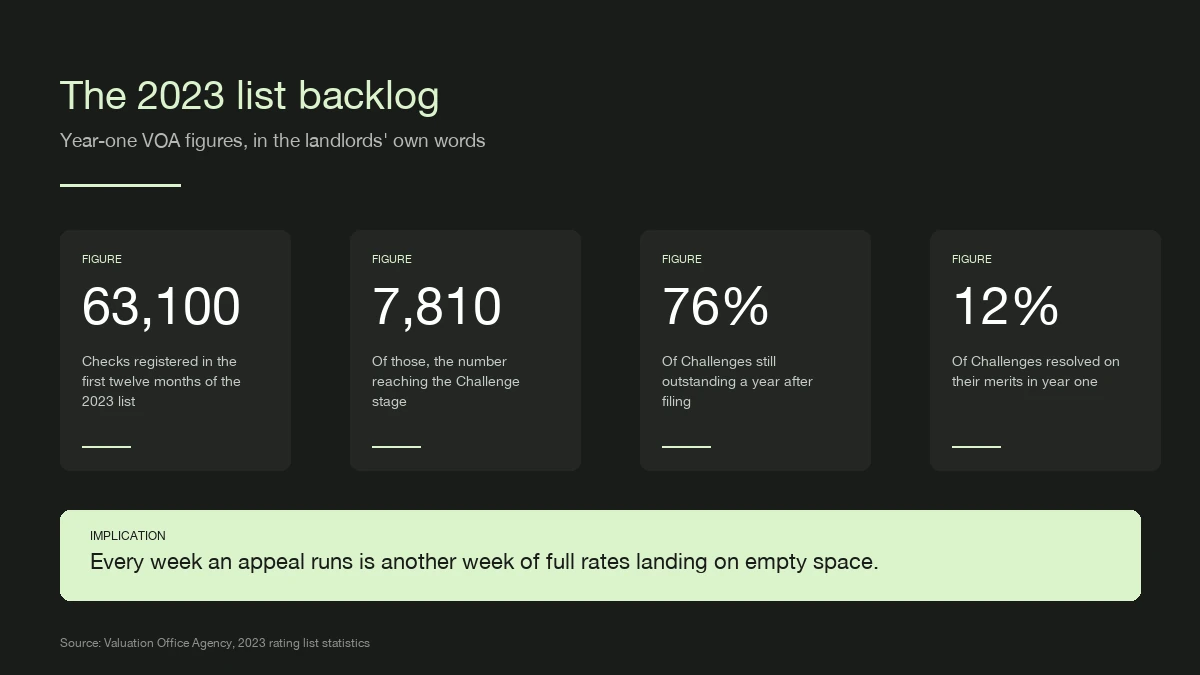
The VOA itself allows up to eighteen months to conclude a Challenge. In practice, rating surveyors will tell you most Challenges are taking the full twelve to eighteen, and complex cases longer. With the 31 March 2026 cut-off now passed, the system is holding a queue of cases that cannot be refreshed but must still be worked through.
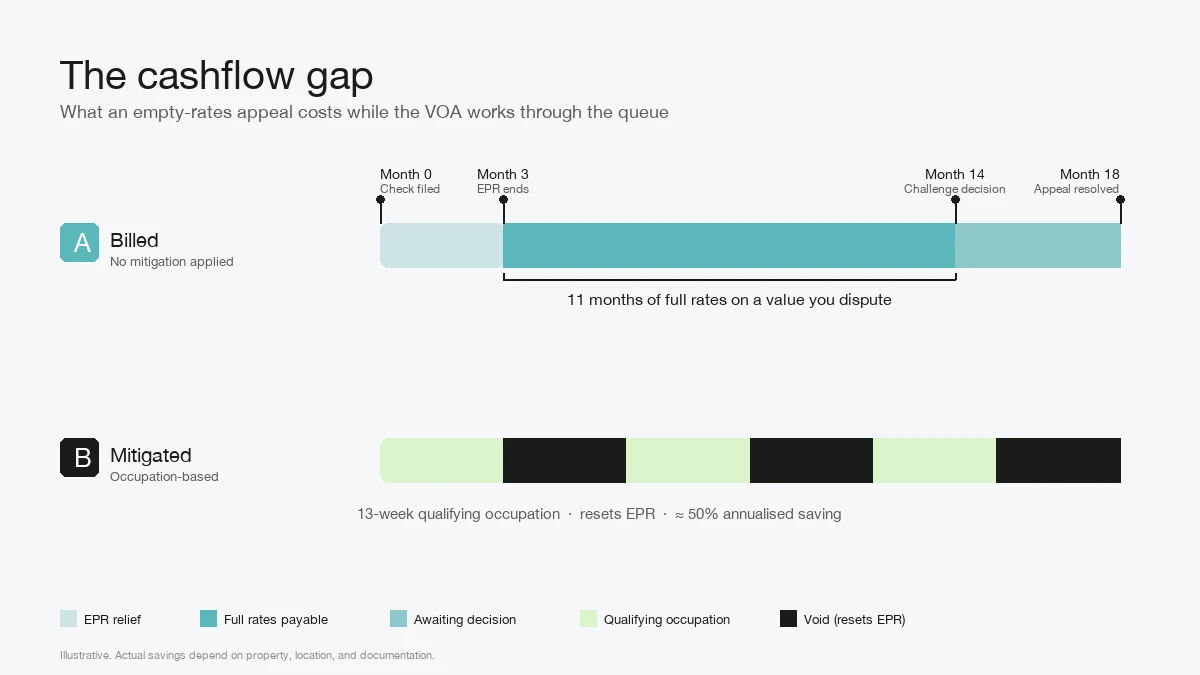
The structural point matters more than any individual delay. Every Check or Challenge you filed against the 2023 list is going to resolve, eventually, on the 2023 list. Between now and that resolution, your rates demand is calculated on the figure you are disputing. If your property is vacant and you have already burnt through the three-month Empty Property Relief window (six months for qualifying industrial), you are paying 100% of a rateable value you believe is wrong, while waiting for the VOA to agree with you.
That is the cashflow gap. And it is getting longer, not shorter.
Appeals do not pause your liability
This is the part that surprises finance directors more than anything else. Filing an appeal does not suspend your liability. You continue to pay rates at the billed amount. If the Challenge eventually succeeds, you get a refund, often credited rather than paid. The interest on what was effectively an interest-free loan to the billing authority is not yours.
For an occupied unit with a viable tenant, this is an annoyance. For an empty unit, it is a structural cost. Take a mid-market high street retail unit with a 2023 rateable value of £80,000. At the current multiplier, that is roughly £41,000 a year in rates once relief ends. If your Challenge sits in the queue for fourteen months before resolution, you have paid close to £48,000 in rates on a unit you believe is overvalued, on top of empty service charges, insurance and asset management costs.
Multiply that across a portfolio and the numbers get serious very quickly.
Case law has quietly moved in landlords’ favour
While the appeals system has been jammed, the courts have been sending a different signal. The direction of travel on occupation-based mitigation has been remarkably consistent, and 2025 produced the clearest ruling yet.
Start with Makro Properties v Nuneaton & Bedworth [2012] EWHC 2250. Makro used around 0.2% of a warehouse of more than 13,000 square metres to store sixteen pallets of documents it was legally required to retain. The High Court found this was actual, beneficial, exclusive occupation. It was not trifling. It was not artificial. It reset the clock.
Then Public Health England v Harlow [2021] and the Poll v Trafford line of cases confirmed that occupation undertaken specifically for rates mitigation purposes, provided it meets the four tests (actual, beneficial, exclusive, non-transient), is not tainted simply because the motive is tax management. That position is long established in English property law and the courts have repeatedly declined invitations to narrow it.
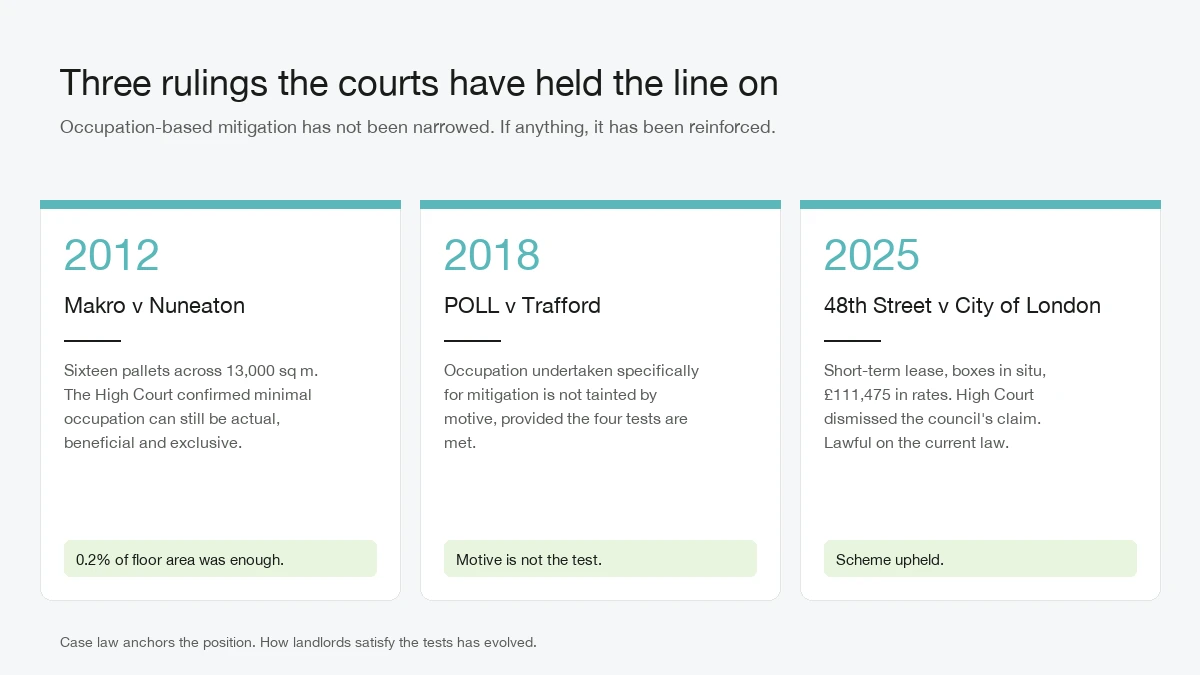
The most recent anchor is The Mayor and Commonality and Citizens of the City of London v 48th Street Holdings Limited and Principled Offsite Logistics [2025] EWHC 1130 (KB). The City of London argued that a short-term occupancy scheme involving a six-week lease and the placing of boxes in the premises had deprived it of £111,475.30 in rates. On 15 May 2025, the High Court dismissed the claim. The scheme was lawful. Leave to appeal has since been granted, so the story is not closed, but the current law stands: a deliberate, short-term, properly documented occupation can reset empty rates relief, and a billing authority cannot strike it down simply because it dislikes the outcome.
The practical read-across
Occupation-based mitigation has not been narrowed by the courts. If anything, it has been reinforced. The operational bar for evidence is higher than it was a decade ago, but the statutory test has not moved: occupation must be actual, beneficial, exclusive and non-transient. Meet those four tests, document them properly, and the relief follows.
The 13-week rule changed the maths, not the model
From 1 April 2024, the reset period extended from six weeks to thirteen. You now need a continuous thirteen-week qualifying occupation to trigger a fresh three-month (or six-month industrial) empty period. Most commentary at the time framed this as the end of occupation-based mitigation. It was not. It was a recalibration.
On the old six-week rule, you could cycle a property roughly every nineteen weeks, giving you something like sixty-four weeks of relief in a calendar year on a vacant unit, with thirteen weeks of billed occupation costs in between. On the thirteen-week rule, you need a longer occupation period, so the arithmetic tightens and the average saving falls, typically landing around 50% of annualised rates rather than the 70%+ achievable pre-2024.
50% saved on an unoccupied £80,000 RV unit is still north of £20,000 a year, per unit. For a portfolio with twenty rolling voids, the number reaches seven figures, before you consider the additional value of having the units actively monitored, insured against squatter and vandal risk, and generating some ancillary utility.
What changed in 2024 was the efficiency of the approach, not its validity. The thirteen-week threshold rewards schemes that can demonstrate genuine, continuous, well-evidenced occupation. It punishes the “box shifting” that the reform was explicitly designed to deter.
What to do while the appeal runs
Three practical moves are worth considering for any portfolio with vacant exposure in 2026.
First, treat your appeals pipeline as a cashflow asset, not an administrative workflow. If your Challenge resolves eighteen months from now and you have been paying the billed figure in the meantime, the eventual refund is a lump sum you already had the use of. Most finance directors prefer that money in their own account, on their own terms. That usually means working backwards from the expected resolution date and running mitigation during the interim.
Second, reconcile the 2023 list appeals with the 2026 valuation now. You have until 31 March 2026 to have lodged Checks on the old list. The 2026 list will open to Challenge from 1 April 2026, and the same backlog dynamics will start building again. Properties whose 2023 value was contested are very likely to warrant a fresh look against the new list. If your appeal argument on the 2023 list turns on comparables or rental evidence, those same points feed the 2026 position.
Third, look honestly at occupation-based mitigation on the vacant part of the portfolio. The case law is sympathetic. The 13-week rule is tighter, but well inside the bounds of the Makro and 48th Street reasoning when implemented properly. The operational bar has risen: occupation must be real, evidenced, and non-transient. That is a test of process, not of principle.
Where technology changes the calculation
The reason occupation-based mitigation has historically been the preserve of specialists is that doing it properly is operationally heavy. Short-term leases, physical stock, on-site presence, security cover and paperwork for each billing authority is a lot of overhead for a saving that only crystallises if the evidence holds up.

This is where the current generation of technology-led mitigation changes the maths. A plug-and-play WiFi router, remotely monitored and documented, can constitute a real, continuous, beneficial use of the premises. Layer on motion cameras, environmental sensors and a local advertising portal and you have occupation that is actual, exclusive, and demonstrably of value to the occupier and the wider community. The evidential trail (router logs, usage data, uptime reports, landing page analytics) is a far cleaner record than a stack of pallets and a signed-in site attendant.
The legal tests have not moved. How you satisfy them has.
Don’t pay twice for a broken system
The cleanest framing to take into your next portfolio review is this. The appeals system is slow because it is structurally overloaded, and the people with the most to lose from that slowness are the owners of vacant property. While you wait, the courts have kept the door open to occupation-based mitigation, and the 2024 reform raised the operational bar without closing the door.
Paying full rates on a unit whose value you dispute, for fourteen months, while the VOA works through a queue, is not a law of nature. It is a choice about what you do with the in-between.
If you have vacant units sitting on the 2023 list, or voids rolling off leases into the 2026 list, the next quarter is the window. Tighten your appeals strategy, map your void pipeline against realistic VOA resolution timelines, and put a mitigation plan in place for the months your appeal will actually take.
The information in this piece is general guidance on UK business rates and is not tax, legal or valuation advice. Specific mitigation strategies should be reviewed against your portfolio by a qualified rating surveyor and your advisers.
Run the numbers on your void pipeline
Use the calculator to see your estimated empty-rates exposure, or talk to us about how technology-led occupation fits your 2023 and 2026 list positions.
Try the calculator Get in touch